
Google Ads can put your pest control company at the top of the page today. No waiting months for SEO. That speed is real, and so is the bill.
Here’s what a click actually costs, what a lead and a booked job cost, and where most pest control ad budgets leak. One thing up front: we don’t run Google Ads. So I’ve got no reason to talk you into them or out of them.
How Google Ads charges you
You pay when someone clicks your ad. Not when they call, and not when they book. Google says your actual cost per click is often less than your max bid, because you only pay what’s needed to beat the advertiser just below you.
Here’s what happens every time someone searches “exterminator near me”:
- A homeowner searchesGoogle checks which advertisers want to show up for that search in that area.
- Google runs an auctionYour bid, your ad and landing page quality, and the search itself all go into your Ad Rank.
- Your ad shows (or doesn’t)A higher Ad Rank gets a higher spot. Showing up is free.
- Someone clicksNow you pay. Usually less than your max bid, just enough to beat the next ad down.
- They call, fill a form, or leaveGoogle gets paid either way. Whether the click turns into a job is on you.
Google lists what goes into Ad Rank: your bid, the quality of your ad and landing page, the competition, and the search itself. Better ads and pages can mean cheaper clicks. That matters later.
Your daily budget is an average, not a hard cap. Google says a campaign can spend up to twice your average daily budget on a busy day, but no more than 30.4 times it over the month. So a $50 a day budget can spend $100 on a Tuesday and still tops out around $1,520 for the month.
What pest control clicks cost
There’s no single price. You’re in an auction, so your cost depends on your city, your services, and who else is bidding. But we do have real benchmarks.
The best large dataset is LocaliQ’s home services search ads benchmarks. It covers 3,211 US home services campaigns from April 2024 to March 2025 and reports medians. One catch: pest control isn’t its own category. These are numbers for home services as a whole.
For a pest-only number, Jake Hundley of Evergrow Marketing, an agency that runs lawn and pest ads, shared his agency’s 2025 numbers in PCT magazine. That’s one agency’s clients, not a national survey, so weigh it that way.
Since pest control isn’t in the LocaliQ report, here’s where its neighbors land. It gives you a sense of the range.
Clicks also cost more or less depending on the search. Our own pest control keyword list has an estimated cost per click for each keyword. Look at the gap between “I need a pro” searches and “I’ll do it myself” searches.
The cheap ones at the bottom are cheap for a reason. People searching “mouse trap” want a trap, not a technician. They’re also the clicks that quietly eat budgets, which we’ll get to.
Cost per lead and cost per booked job
Cost per click is the number agencies love to quote. It’s the least useful one. What you really want to know is what each booked job cost you.
The math is simple once you have your own numbers:
Is $200 a job good? It depends what the job is worth. A one-time visit runs about $300 to $550, and quarterly service runs about $100 to $300 per visit, so $400 to $1,200 a year for a plan customer.
If those booked jobs turn into plans, $200 can be a great deal. If they’re one-and-done price shoppers, it’s thin.
Small changes swing this a lot. Drop the close rate from 50% to 25% and the same $1,600 costs you $400 per booked job. That’s why answering the phone fast matters as much as anything you do inside Google Ads.
Pest searches swing with the seasons
Pest control is seasonal, and so is search. I pulled five years of Google Trends data for “pest control” in the US and averaged it by month.
July sees more than twice the search interest of December. Specific pests swing even harder. In the same five years, “mosquito control” peaked in June at about 3.5 times its December level, and “termite treatment” peaked in May, which lines up with swarm season.
What that means for ads:
- More searches in summer means more clicks to buy, and usually more advertisers fighting for them. Your budget can run out earlier in the day.
- Winter is quiet. Fewer searches, but also fewer competitors. It can be a cheaper time to test.
- Plan termite and mosquito campaigns ahead of their peaks, not in the middle of them.
When Google Ads make sense, and when they don’t
When ads flop for a pest control company, the ads often aren’t the problem. The setup around them is.
| Item | Good time for ads | Bad time for ads |
|---|---|---|
| Phones | Someone answers every call during business hours | Calls go to voicemail and get returned tomorrow |
| Website | A page for each service that works on a phone | One slow homepage with a tiny phone number |
| Tracking | Every call and form is tied back to its source | You’re guessing which leads came from ads |
| Goal | Fill a new area, a new service, or the busy season | Replace a website nobody can find |
| Budget | Enough clicks a month to learn something | A few dozen clicks, then a verdict |
On that last row: at $8 a click, $300 a month buys about 37 clicks. At an 8% conversion rate, that’s about 3 leads. That’s not enough to tell whether ads work for you. It’s a coin flip.
Ads also make the most sense for high-value work. A bed bug or termite job can pay for a lot of clicks. A one-time ant spray, less so.
Where pest control ad money leaks
Most wasted spend comes from the same handful of mistakes. Evergrow found six words, “spray,” “repellant,” “trap,” “killer,” “bait,” and “poison,” were eating up over 25% of their clients’ budgets. Those are DIY shoppers.
- Broad match on everything. It’s Google’s default, and Google says it can show your ad on searches that are only related to your keyword.
- No negative keywords. Without them, you pay for "mouse trap," "ant killer" and "how to get rid of roaches" clicks.
- Sending ad clicks to your homepage. Someone who searched "termite treatment" should land on a termite page with your number up top.
- No call tracking. Most pest control leads call. If you only count forms, you can’t see what’s working.
- Never reading the search terms report. That’s where you see the actual searches you paid for.
- Set it and forget it. Seasons, competitors and prices change every month.
A few notes from Google’s own help pages. Broad match is the default for every keyword you add, and it reaches the most searches. Phrase and exact match give you more control. Negative keywords stop your ad from showing on searches you don’t want.
For calls, Google can track calls straight from your ads, and calls to a forwarding number on your website from people who clicked an ad. If you only track taps on your phone number, Google says it can count the tap but not the call itself.
Hiring someone to run your ads? Ask them one thing: “What will my cost per booked job be, and how will I see it?” If they can only talk about clicks and impressions, keep looking.
Google Ads vs Local Services Ads vs SEO
Google Ads aren’t the only way to show up on Google. Here’s how they compare with Local Services Ads and SEO.
| Item | Google Ads | Local Services Ads | SEO |
|---|---|---|---|
| You pay for | Each click | Each valid lead | The work, monthly or your own time |
| Pay if they don’t call? | Yes, for every click | No | No |
| How fast it starts | Days | Days to weeks | Months |
| Who gets the lead | Only you | Only you | Only you |
| When you stop paying | Ads stop showing | Ads stop showing | Rankings fade slowly, not overnight |
| Best for | High-value services, new areas, busy season | Steady calls when you only want to pay per lead | Lowering your cost per lead over time |
With Local Services Ads, Google says you’re charged for each valid lead, and leads it judges invalid or low quality aren’t charged. That’s a real advantage over paying per click. We compare the two in detail in Local Services Ads vs SEO.
How Ads and SEO work together
This doesn’t have to be one or the other. Used well, they help each other.
- Ads cover the gap. SEO takes months. Ads can keep the phone ringing while it builds.
- Ads show you what converts. Your search terms report shows which searches turned into calls. Those are the pages your website should build first.
- SEO lowers what you need to spend. Once your site and Google profile show up for a search, you can test cutting ad spend on that search and watch your total calls.
- Good pages make ads cheaper. Google counts landing page quality in Ad Rank. A strong service page helps both.
That last point is where most of our work lands. We build and run your website, Google Business Profile, local SEO and call tracking. We don’t run Google Ads or Local Services Ads. If you want ads, hire a specialist or run them yourself, and point them at good service pages.
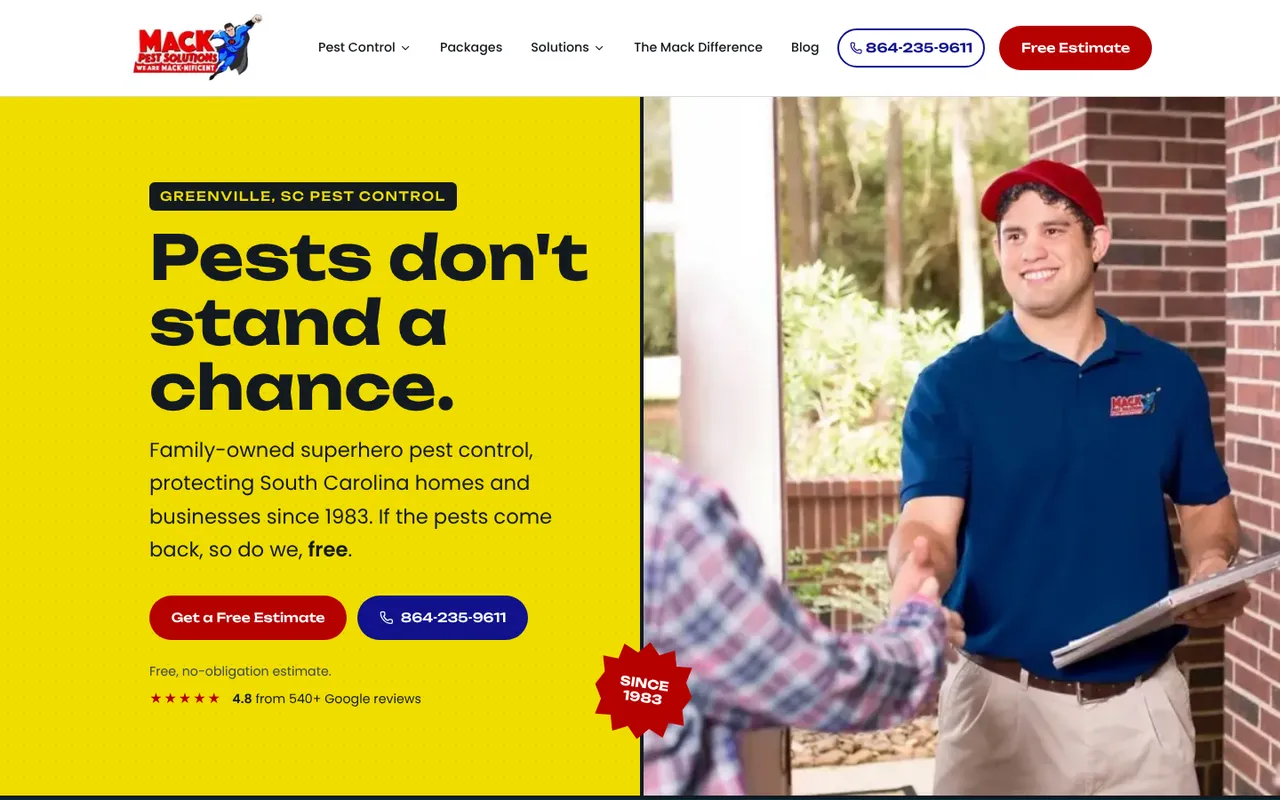
For our client Mack Pest Solutions in Greenville, SC, the average Google position for “pest control Greenville SC” went from #19 (June to October 2025) to #9 (August to October 2026). From June to September 2026, Google search sent them about 19 call-button taps and 10 form fills a month, with no ad bill attached.
The details are in the Mack Pest Solutions case study. Every market is different, so nobody can honestly promise you the same.
Before you spend a dollar
- Know what a customer is worth to you: first job and a year of service.
- Work out the most you can pay per booked job and still make money.
- Set up tracking for every call and form, from ads and from everywhere else.
- Build a landing page for each service you advertise, with your phone number up top.
- Make sure someone answers the phone during the hours your ads run.
- Start with phrase and exact match, not broad match on everything.
- Add negative keywords for DIY words like spray, trap, killer, bait and poison.
- Set your service area to where you actually go.
- Plan to read the search terms report every week for the first month.
- Budget for enough clicks to learn something, and give it a fair test.
Google Ads can be a good tool for a pest control company. They’re a bad replacement for a website people can find and a phone someone answers. Fix those first, and every ad dollar works harder.
For the full picture of where ads fit with everything else, read our pest control marketing guide. For what SEO costs by comparison, see how much pest control SEO costs.
Our price is a flat $1,000 a month with no fee per lead, no contract and no setup fee, and you pay nothing until your new site is live. See what’s included on our pricing page. We work with one pest control company per city, so check if your city is still open and see where you show up in Google’s local listings today. Or get a free audit and I’ll tell you straight whether you need ads, SEO, or both.
Frequently asked questions
- How much does Google Ads cost for a pest control company?
- You set the budget, and Google charges per click. LocaliQ's 2025 home services benchmarks found a median cost per click of $7.85 and a median cost per lead of $90.92 across home services (pest control isn't its own category there). Evergrow Marketing, writing in PCT magazine, reported an average pest control click of $5.99 and an average lead of about $98.12 on Google in 2025. Your city, your services and your competition will move those numbers.
- What is a good cost per lead for pest control Google Ads?
- There isn't one right number. It depends on what a customer is worth to you. A $100 lead is cheap if half of them book and sign up for a quarterly plan worth $400 to $1,200 a year. It's expensive if most of them are price shoppers who never book. Track calls and forms back to the ad, then work out your cost per booked job.
- Should I run Google Ads or Local Services Ads?
- They charge differently. Google Ads charge per click, whether or not the person calls. Local Services Ads charge per valid lead, and Google says leads it judges invalid aren't charged. Many pest control companies try Local Services Ads first because you only pay when someone reaches out. Google Ads give you more control over keywords, ad text and landing pages.
- Can I stop running Google Ads once my SEO is working?
- Often you can spend less, but test it rather than switching everything off at once. When your site and Google profile start showing up for the searches you were paying for, cut ad spend on those terms and watch your total calls. If calls hold, keep the savings. If they drop, the ads were still pulling their weight.
Read more
Local SEO for pest control companies: the complete guide
How pest control companies get found on Google Maps, in local results and in AI answers: your profile, reviews, city pages, listings and tracking.
Best pest control websites: real examples and what they get right
12 real pest control websites with desktop and phone screenshots, plus the specific things each one does well that you can copy on your own site.