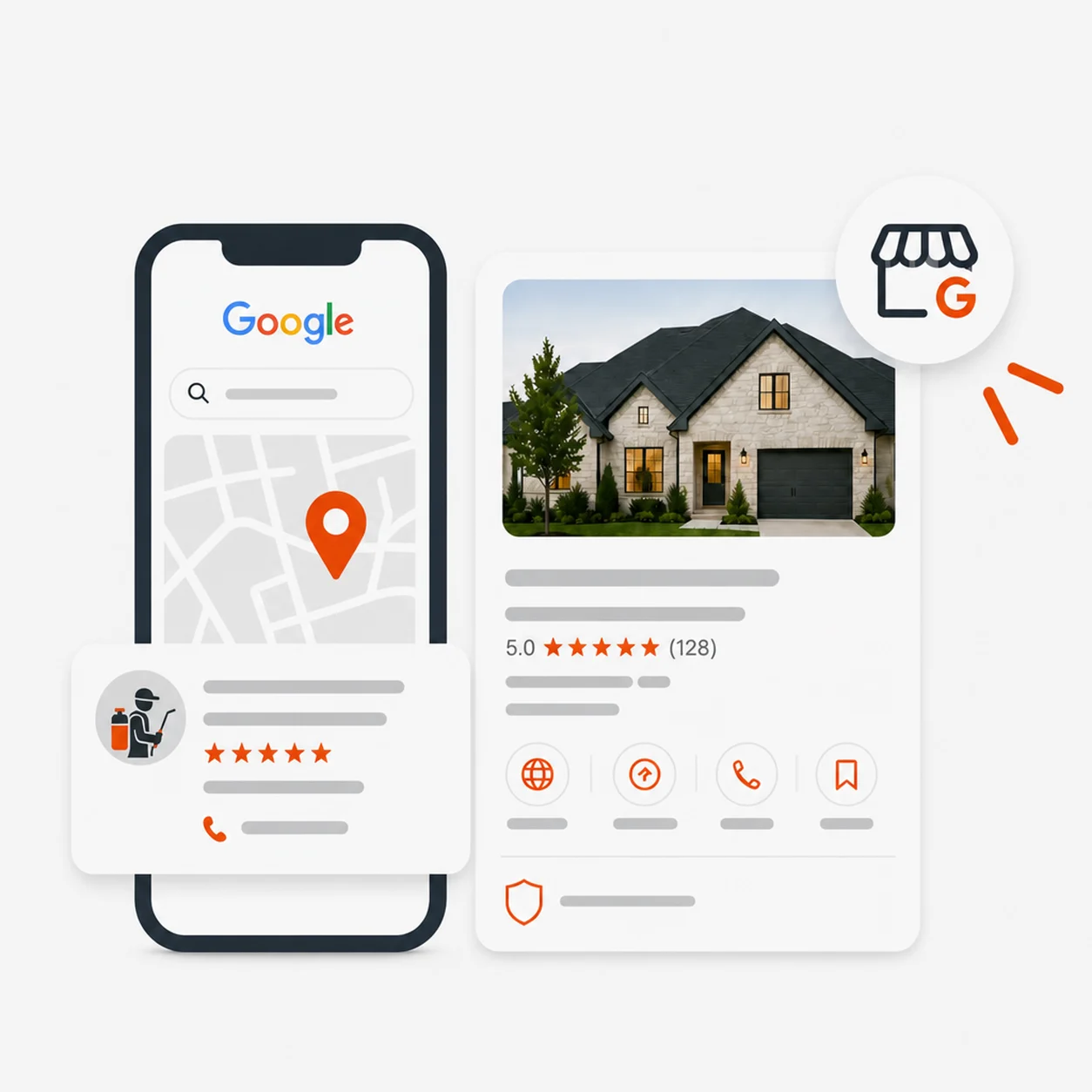

When someone finds ants in the kitchen, they grab their phone and search “pest control near me.” Google shows a map with a few companies on it. Most people call one of those.
Local SEO is how you get on that map, and stay there. This guide covers all of it, in the order I’d do it.
What local SEO is
Google shows two kinds of results for a local search. Up top is the map pack: a map and usually three businesses. Below that are the regular results, which are web pages.
You need both, but they run on different fuel:
| Item | Map pack | Regular results |
|---|---|---|
| Where it shows | Top of the page, with a map | Below the map |
| What ranks | Your Google Business Profile | Pages on your website |
| What moves it | Categories, distance, reviews, profile details | Page content, links, site quality |
| What a tap does | Calls you, gets directions, or opens your site | Opens your website |
| Where it also shows | Google Maps app | AI answers that cite web pages |
The map pack is where most of the calls are for “pest control near me” type searches. Your website still matters, because it feeds the map pack and wins the searches where the map doesn’t show.
What Google looks at
Google doesn’t publish its formula. The best outside view is Whitespark’s 2026 Local Search Ranking Factors survey, where 47 local SEO experts scored 187 factors.
Here are the top 10 for the map results:
A few of these you can’t change. Most pest control companies are service-area businesses, and Google’s rules say to hide your address if customers don’t come to you. So distance and address work against you outside your home town.
That’s why the rest matter so much. Category, hours, reviews and a clean profile are all in your hands.
Your Google Business Profile, set up for pest control
This is the single most important piece. Go through it line by line:
- Primary category: "Pest control service".
- Secondary categories only for work you really do, like "Animal control service" or "Bird control service". Check the live list in your profile.
- Business name exactly as it appears on your trucks and sign. No added cities or keywords.
- Service areas: the cities and ZIP codes you really serve, within about 2 hours of driving from your base.
- Address hidden if customers don't come to your office.
- Services: every service you sell, each with a short plain description. Termites, mosquitoes, rodents, bed bugs, ants, wildlife, commercial.
- Hours: your real customer-facing hours, plus holiday hours.
- Phone: a number a person answers during those hours.
- Website link: your home page or the matching city page, with tracking tags so you can see the visits.
- Description: what you do, where, and what makes you different. Plain words.
- Photos: real trucks, techs in uniform, your team, your office. Add new ones every month.
- Posts: a short seasonal post a few times a month, like termite swarm season or spring ant calls.
- Chat: turn on text or WhatsApp messaging if your profile offers it, and answer fast.
- Reviews: reply to every single one.
Two notes on that list. When I last checked, Google had no separate termite or mosquito category, so that work belongs under Services. And in Whitespark’s survey, keywords in your profile’s services list jumped from #110 to #35, so take that section seriously.
What about Q&A? Google removed the Q&A section from profiles in late 2025. In its place, the Google Maps app has an AI “ask” feature that writes answers from your profile, photos, reviews and website.
So put real answers on your website’s FAQ and service pages. That’s now where those questions get answered.
Messaging changed too. Google shut down its old chat feature in July 2024. The newer option lets you add a text or WhatsApp number under Contact, but it’s only in select regions.
Reviews: the part most companies get wrong
Your reviews do two jobs. They help you rank, and they decide who gets the call. BrightLocal’s 2026 Local Consumer Review Survey of 1,002 US consumers shows how picky people are:
Fresh reviews and replies matter just as much as the stars:
So a big review push once a year doesn’t cut it. You need a few new reviews every month, from every crew. Here’s the routine I give clients:
- Get your review link and QR codeIn your Business Profile, open Read reviews, then the option to get more reviews. Google only lets you make the link or QR code from a computer browser, so do it once and save both.
- Ask in person at the end of the jobThe tech explains what they treated, then asks: "Would you mind leaving us a quick Google review?" Put the QR code on a card or the invoice.
- Text the link the same daySend a short text with the link while the visit is fresh. Ask every customer, not only the ones you think are happy.
- Follow up onceIf there's no review after a few days, send one friendly reminder. Then stop.
- Reply to every review within a dayKeep it short and personal. 32% of consumers expect a reply by the next day, and half say they are unlikely to pick a business that uses generic, copy-paste replies.
City and service area pages
Your profile covers your area in one shot. Your website needs pages for the towns you want more jobs from, because that’s what ranks in the regular results for “pest control in [town].”
This is where most sites go wrong:
| Item | Done wrong | Done right |
|---|---|---|
| Which towns | Every town within 100 miles | Towns you really serve and want more work from |
| The writing | One page copied, city name swapped | Written for that town |
| Local detail | None | Neighborhoods, local pests by season, your drive time |
| Proof | Stock photos | Jobs, photos and reviews from that town |
| Links | Hidden pages nobody can reach | Linked from your service area page and menu |
| Next step | A form at the bottom | Tap-to-call phone and a short quote form up top |
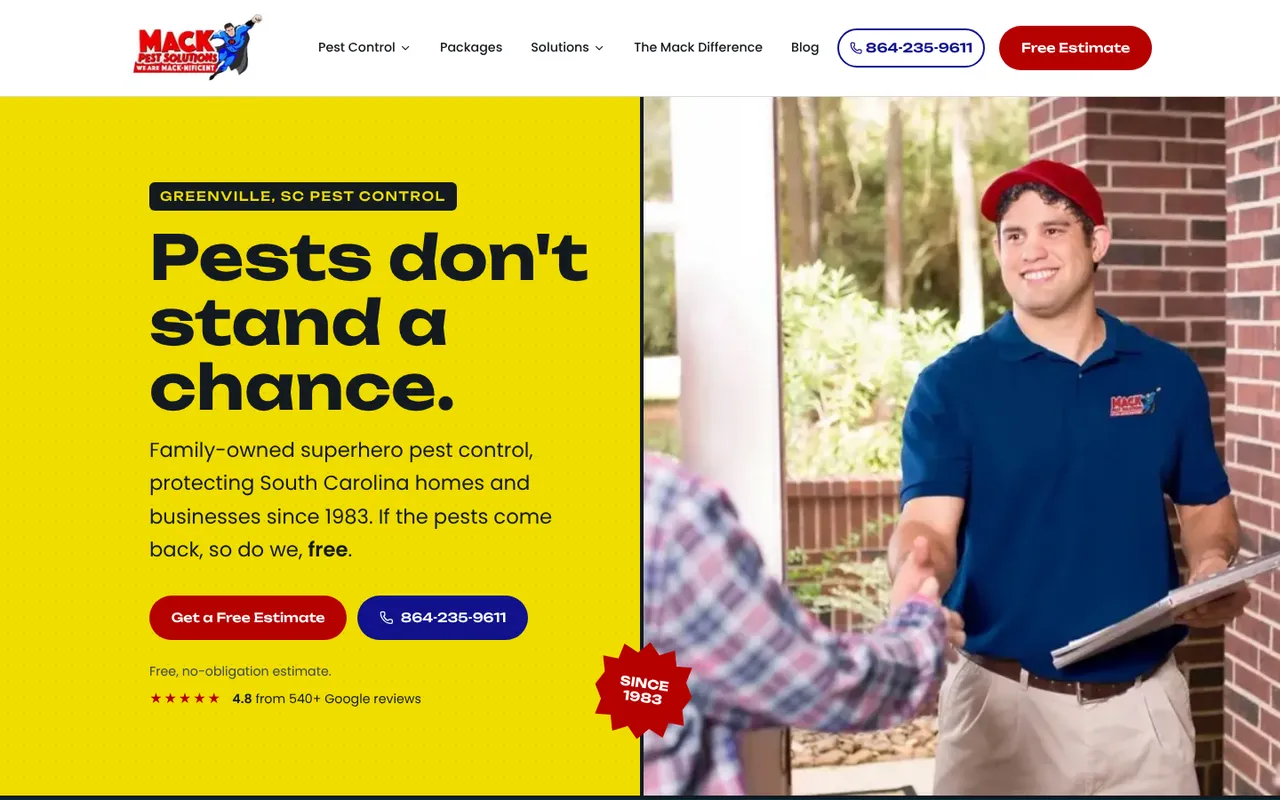
Start with your top three to five towns. Five good pages beat fifty thin ones. It’s the same approach we used for Mack Pest Solutions, below.
Citations: same name, address and phone everywhere
A citation is any listing of your business name, address and phone number (your NAP). They should match your Google profile exactly, down to “St.” vs “Street.”
Whitespark’s survey says citations matter less for map rankings than they used to. But it also found that 3 of the top 5 factors for AI search visibility are citation factors. So they’re worth getting right.
These are the ones that matter for pest control:
- Google Business Profile
- Bing Places for Business (now at bing.com/forbusiness, and it can import your Google profile)
- Apple Business (formerly Apple Business Connect), for Apple Maps and Siri
- Yelp (claiming your page is free)
- Better Business Bureau (a basic listing is free, accreditation is paid)
- Angi
- Nextdoor (free business page)
- Facebook business page
- NPMA Find-A-Pro on PestWorld.org (included with NPMA membership)
- Your state pest control association's member directory, if it has one
- Your own website footer and contact page
Don’t skip Apple. In BrightLocal’s 2026 survey, 27% of consumers used Apple Maps to find local businesses, up from 14%. Bing announced its new free Bing Places in October 2025, with a Google import.
Tracking: know which calls came from where
If you can’t see where your calls come from, you’re guessing. Your profile’s Performance screen helps, but its call count only includes people who tapped “Call” on a phone. And Google ended call history reports in July 2024.
Here’s the minimum setup:
- Call tracking. A tracking number on your website shows which calls came from Google, Maps, ads or your truck wrap.
- Tagged profile link. Add tracking tags to your profile’s website link, so profile visits show up separately in your analytics.
- Form tracking. Every quote form should note the page it came from.
- One monthly look. Calls and forms by source, next to your rankings. Fifteen minutes is enough.
Every plan we sell includes call and form tracking and a plain-English monthly report.
AI search: the new front door
Homeowners don’t only search Google anymore. They ask ChatGPT, Gemini, Perplexity and Google’s AI Mode, “Who’s the best exterminator near me?” BrightLocal’s 2026 AI study shows how fast this grew:
The good news: you don’t need a separate plan. These tools build their answers from what’s already out there about you. That’s your Google profile, your reviews, your website and your listings on other sites.
That last stat is the key one. Even when AI names you, people still go check your reviews before they call. Everything in this guide helps with both.
No one can promise you’ll be named by an AI tool, and you should be wary of anyone who does. Here’s how we handle AI search.
Proof: Mack Pest Solutions in Greenville, SC
Mack Pest Solutions is a pest control company in Greenville, South Carolina. We rebuilt their website in spring 2026 and run their local SEO.
Their average Google position for “pest control Greenville SC” went from #19 (June to October 2025) to #9 (August to October 2026).
One company in one city isn’t a promise for yours. But it shows what steady, honest work can do. The full story is in the Mack Pest Solutions case study.
Your first 30 days
If you want to do this yourself, here’s the order I’d go in:
- Day 1: See where you standRun our free city check to see where you show up in Google's local listings today. Write the numbers down so you can compare later.
- Days 2 to 3: Fix your Google profileWork through the checklist above: category, services, service areas, hours, photos and chat.
- Days 4 to 7: Match your listingsClaim Bing, Apple, Yelp, BBB, Facebook and Nextdoor. Make the name, address and phone match your Google profile exactly.
- Week 2: Start the review routineGive every tech the QR card and the text template. Reply to every new review within a day.
- Week 2: Set up trackingAdd call tracking to your website and tracking tags to your profile link, so next month you know what worked.
- Week 3: Build your top pagesWrite or fix your main service pages and your first one or two city pages, the right way.
- Week 4: Post, add photos, measurePost something seasonal, upload new job photos, and compare calls and forms to last month.
After that, it’s the same routine every month. Reviews, photos, posts, a new page or two, and a look at the numbers.
Want us to do it for you?
This is exactly what we do, and only for pest control companies. It’s a flat $1,000 a month. No per-lead fees, no contract, no setup fee, and you pay nothing until your new site is live. See everything that’s included on our pest control SEO page and our pricing page.
We work with one pest control company per city. Check if your city is still open, and see where you show up in Google’s local listings right now. Or get in touch and I’ll tell you what I’d fix first.
Frequently asked questions
- How long does local SEO take for a pest control company?
- Profile fixes like the right category, services and hours can be done in a day or two. Bigger moves usually take months. For our client Mack Pest Solutions, the new site launched in May 2026, and the average Google position for "pest control Greenville SC" went from #19 (June to October 2025) to #9 (August to October 2026). Every market is different, so nobody can honestly promise a ranking or a date.
- Can I show up in the map pack in a city where I don't have an office?
- It's harder. In Whitespark's 2026 survey, distance to the searcher and having an address in the city searched are both top 5 map factors. You can still show up for people near your base, and strong reviews, the right categories, a full services list and real city pages on your website help everywhere you work. Don't fake an office address. It isn't worth losing your profile.
- What's the most important setting in my Google Business Profile?
- Your primary category. Whitespark's 2026 Local Search Ranking Factors survey ranks it #1 for the map results. For most pest control companies it should be "Pest control service." Add secondary categories only for work you really do, and list termite, mosquito and rodent work under Services.
- Do ChatGPT and Google's AI use my reviews and listings?
- These tools build answers from what's published about you: your Google profile, reviews, website and listings on other sites. Whitespark found that the AI answers in Google Maps draw on reviews and profile details. BrightLocal found that 45% of US consumers used AI tools for local business recommendations in 2026. Nobody can guarantee an AI mention, but accurate, consistent information and steady reviews give these tools better material to work with.
Read more
Best pest control websites: real examples and what they get right
12 real pest control websites with desktop and phone screenshots, plus the specific things each one does well that you can copy on your own site.
Google Ads for pest control: what it really costs
What Google Ads cost a pest control company: real cost per click data, cost per lead and per booked job math, seasonal swings, and where the money leaks.