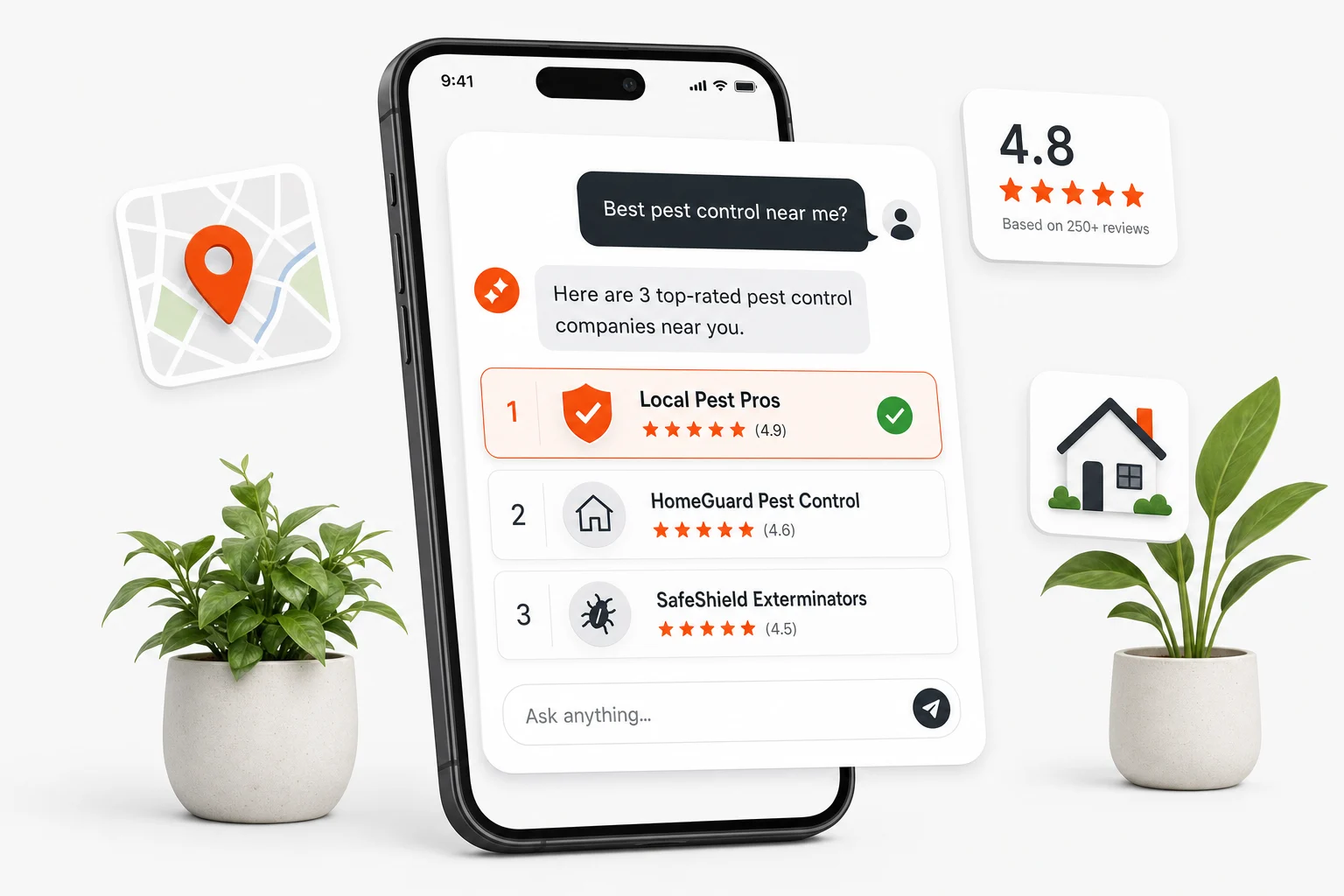

More homeowners now skip Google and ask an AI: “Who’s the best exterminator near me?” The AI answers with two or three names. If yours isn’t one of them, that call goes somewhere else.
I’ll show you where each AI tool gets its answers, the six things that help, and a simple test you can run every month. I’ll also tell you what nobody can promise you, because a lot of people are selling “AI rankings” right now.
How AI assistants pick a pest control company
There’s no secret list. When someone asks for a local company, these tools search the web and maps data right then, read what they find, and write a short answer.
So the AI can only recommend you based on what’s already published about you. That’s four things: your Google Business Profile, your reviews, your website, and your listings and mentions on other sites.
If those are thin, wrong or don’t match, the AI has nothing solid to say. If they’re strong and consistent, you’re easy to recommend.
Where each AI tool gets its answers
Each tool works a bit differently. Here’s what their own documentation says:
| Item | Where it looks | What to check |
|---|---|---|
| ChatGPT | Live web search through partner search providers, plus your rough location from your IP address | Your site allows OAI-SearchBot. Bing Places is claimed. |
| Google AI Overviews and AI Mode | Google's search index, with many related searches run at once | Your pages are indexed and nothing blocks Googlebot |
| Gemini | Google Search and Google Maps: places, reviews, photos, addresses, hours | Your Google Business Profile and reviews |
| Perplexity | Its own web crawler, plus Yelp data for local businesses | Your site allows PerplexityBot. Your Yelp page is claimed. |
| Siri and Apple Maps | Apple Maps place cards | Your Apple Business listing (formerly Business Connect) |
ChatGPT
OpenAI’s help page on ChatGPT search says it searches the web when a question needs current info. It rewrites the question into one or more searches and sends them to its search providers.
It may use an approximate location from the user’s IP address for local results, and it can show a map on phones. OpenAI doesn’t list every provider, but the page points to Microsoft’s privacy policy. That’s one more reason to claim your free Bing Places listing.
The same page says a site must allow OpenAI’s search crawler, OAI-SearchBot, to show up. And it says plainly: “Placement is not guaranteed.”
Google AI Overviews and AI Mode
Google’s page on AI features and your website is refreshingly direct. To show up, a page must be indexed and eligible to show in Google Search with a snippet. Google says there are no extra requirements and no special optimizations needed.
Both features may use “query fan-out,” running many related searches at once to build one answer. So a page that answers the follow-up questions (cost, safety, how long) gives Google more to work with.
Gemini
Gemini leans on Google’s own data. Google’s documentation for Grounding with Google Maps says it pulls places, reviews, photos, addresses and opening hours from a database of over 250 million places.
That’s your Google Business Profile and your Google reviews. If those are weak, Gemini has little to go on.
Perplexity
Perplexity’s crawler page says PerplexityBot is how it surfaces and links websites in its search results. It recommends allowing PerplexityBot in your robots.txt if you want to show up.
For local businesses, Perplexity added Yelp data in March 2024: maps, photos and reviews. Claim your Yelp page and keep it accurate.
Siri and Apple Maps
Apple says the info you manage in Apple Business Connect (now called Apple Business) reaches Apple Maps, Messages, Wallet, Siri and other apps. It’s free.
When someone asks Siri for pest control nearby, your Apple Maps place card is what it has to work with. Claim it and fill it out.
What moves AI answers
None of these companies publish a formula. The best outside view is Whitespark’s 2026 Local Search Ranking Factors, where 47 local SEO experts scored 187 factors. New this year, they scored each one for AI search visibility.
Here’s their top 10:
Whitespark’s own summary: “3 of the top 5 AI Search visibility factors are citation factors.” A citation here is any mention of your business on another site, not just a directory listing.
Look at what’s not on that list: tricks. It’s mentions, pages, reviews and focus. That’s the same work that wins in Google, which is good news. You don’t need a separate plan.
Step 1: Fill out every profile AI reads
Your Google Business Profile feeds Google’s AI and Gemini directly. Bing and Apple feed the others. Here’s what to get right on all three:
- Google Business Profile: primary category "Pest control service", real service areas, real hours.
- Services list: every service you sell (termites, mosquitoes, rodents, bed bugs, ants, wildlife, commercial), each with a short plain description.
- Photos: real trucks, techs and jobs. Add new ones every month.
- Bing Places for Business: claim it. You can import your Google profile.
- Apple Business (formerly Apple Business Connect): claim your Apple Maps place card for Siri and Apple Maps.
- Yelp: claim your free page and fix any wrong details. Perplexity uses Yelp data.
- Same name, phone, hours and website on all of them, matching your Google profile exactly.
The full profile walkthrough is in my local SEO guide for pest control.
Step 2: Get reviews that say something
Reviews do double duty. They’re one of the things AI tools read, and they’re what people check after the AI names you.
BrightLocal found that 97% of people who use AI for local picks sometimes double-check them against real reviews. And Scorpion’s 2026 survey found that 87% of homeowners won’t consider a pest control company rated below 4 stars.
A review that says “Great service!” helps your rating. A review that says “They fixed our mouse problem in the attic in two visits, Travelers Rest” tells an AI what you do and where. When you ask for a review, it’s fine to say “It helps if you mention what we treated.” Never write it for them, and never pay for it.
Step 3: Build pages that answer real questions
“A dedicated page for each service” is #2 on Whitespark’s AI list. AI tools quote pages that answer the exact question someone asked. A home page that says “we handle all your pest needs” answers nothing.
| Item | Hard for AI to use | Easy for AI to quote |
|---|---|---|
| Services | One "Services" page with a bullet list | One page per service: termites, rodents, mosquitoes, bed bugs |
| Towns | A list of 40 town names in the footer | Real pages for your top towns, with local pests and drive times |
| Answers | "Call for details" | Plain answers: how it works, how long, is it safe for pets, what it costs or what affects the price |
| Format | Walls of text, or prices in an image or PDF | Short sections, headings, bullets, real text |
| Proof | Stock photos | Your trucks, your techs, your license number, your reviews |
Write each answer near the top of its section. Lead with the answer, then explain. That helps the homeowner and the AI the same way.
Want to see what this looks like done well? I broke down a few in the best pest control websites.
Step 4: Add structured data that matches the page
Structured data (schema) is code that spells out who you are, what you do and where, so software doesn’t have to guess. It won’t get you named by itself. Google says there’s “no special schema.org structured data” needed for its AI features, and that your structured data should match the visible text on the page.
There’s no pest control type on schema.org. When I checked, the closest fit was HomeAndConstructionBusiness, a type of LocalBusiness. For a service-area pest control company, the useful fields are:
- name: your business name, exactly as on your Google profile
- url and telephone: your home page and main phone number
- areaServed: the towns you really serve, like Greenville, Greer and Simpsonville
- openingHours: your real customer-facing hours
- sameAs: links to your Google, Facebook, Yelp and BBB pages, so software can tie them together
Use your real name, phone and hours, exactly as they appear on your Google profile. If the info in your schema doesn’t match your page, that’s worse than having none.
Step 5: Get mentioned on the sites AI trusts
This is the step most companies skip, and it’s three of Whitespark’s top five. AI tools trust what other respected sites say about you more than what you say about yourself.
Here’s where a pest control company can earn mentions:
- Best-of lists in your local paper, city magazine or “best of [town]” awards. Enter them.
- Industry sites: the NPMA Find-A-Pro directory on PestWorld.org (with NPMA membership) and your state pest control association.
- Local news and blogs: a quick tip piece on termite swarm season or mosquito season, with your name on it.
- Community sites: your chamber of commerce, BBB, Nextdoor, and sponsor pages for the teams and events you support.
- Review sites beyond Google: Yelp, BBB, Angi and Facebook, all with matching details.
Make sure your name, phone and website match everywhere. When listings disagree, AI tools have a harder time trusting any of them.
Step 6: Don’t block AI crawlers by accident
This one is a quick check, and it can quietly wipe you out. OpenAI says “Sites that are opted out of OAI-SearchBot will not be shown in ChatGPT search answers.” Changes take about 24 hours to kick in.
Each bot does a different job, so you can block training without blocking search:
| Item | What it does | My advice |
|---|---|---|
| OAI-SearchBot | Shows your site in ChatGPT search answers | Allow |
| ChatGPT-User | Visits a page when a ChatGPT user asks about it | Allow |
| GPTBot | Collects content to train OpenAI's models. Separate from search. | Your choice |
| PerplexityBot | Shows and links your site in Perplexity results | Allow |
| Googlebot | Google Search, including AI Overviews and AI Mode | Always allow |
| Bingbot | Bing search results | Always allow |
Open yourdomain.com/robots.txt in your browser. If you see “Disallow: /” under any of the bots marked Allow, have your web person fix it. The simplest safe setup is two lines: User-agent: * and Allow: /, plus a line pointing to your sitemap.
If your site uses Cloudflare
Cloudflare can block AI bots at the network level, even when your robots.txt says yes. Google’s own page says crawling must be allowed “by any CDN or hosting infrastructure,” and Cloudflare is one of those.
Cloudflare’s docs say the old “Block AI bots” switch is being replaced by “Configure AI bot policies,” with three groups: Search, Agent and Training. The docs also say that blocking Training blocks crawlers that do both search and training.
Test what AI says about you every month
You can’t fix what you don’t measure. Answers change from person to person and day to day, so one check means little. The same check every month shows you the trend.
Here’s the prompt list I’d use. Swap in your town, a nearby town, and your company name:
- Who's the best pest control company in [your town]?
- Recommend an exterminator near [a ZIP code you serve].
- Who does termite inspections in [your town]?
- I have mice in my attic in [nearby town]. Who should I call?
- Best mosquito control service in [your town]?
- Who treats bed bugs in [your town], and what do reviews say?
- What do people say about [your company name]?
- What services does [your company name] offer, and what areas do they cover?
The last two catch wrong facts. If an AI says you don’t do termites, or gets your service area wrong, that’s a profile or page you need to fix.
- Pick the same day each monthThe first Monday works. Use the same eight prompts every time, so you compare apples to apples.
- Run them in each toolChatGPT (with search on), Google (look for the AI Overview, then try AI Mode), Gemini and Perplexity. On an iPhone, ask Siri the first one out loud. Start a new chat each time, ideally in a private window where you're not logged in.
- Write down four thingsWere you named? What spot? Who was named instead? Which sources did it cite? A simple spreadsheet is enough.
- Look at the sourcesIf a tool keeps citing a list, directory or article you are not on, that is your to-do. Get listed there, or get more reviews on the site it trusts.
- Fix wrong facts at the sourceIf the AI has your hours, services or area wrong, find where it got that and correct it there: your Google profile, website, Yelp or Bing.
Also check your analytics for visits coming from sites like chatgpt.com and perplexity.ai. That’s how we spot AI visits for our clients.
Proof: what we’re seeing at Mack Pest Solutions
Mack Pest Solutions is a pest control company in Greenville, SC. We rebuilt their website in spring 2026 and run their SEO, including the AI search work above.
Here’s what AI assistants like ChatGPT sent them, from their Google Analytics:
Let’s be honest about the size of that. Eight visits a month is small. From June to September, organic search sent Mack about 327 visits a month on average.
But it went from zero to something, and it’s growing. Their average Google position for “pest control Greenville SC” also went from #19 (June to October 2025) to #9 (August to October 2026). The full Mack Pest Solutions story has the details.
What nobody can promise
I’ll say it plainly: nobody can guarantee you’ll be recommended by ChatGPT, Google AI or anyone else. Not me, not any agency. OpenAI itself says placement isn’t guaranteed.
These tools decide what to say, the answers change between people, and the companies change how they work all the time. Here’s what to watch out for when someone pitches you “AI SEO”:
- A guarantee that ChatGPT or Google AI will name you.
- A "partner" deal or paid submission to get into ChatGPT answers.
- A big setup fee for an llms.txt file or "AI schema" alone.
- Fake reviews, or paying customers for reviews.
- No plan to show you what the AI tools actually say about you each month.
- A separate "GEO" retainer on top of SEO that does the same work.
What you can control is how easy you are to recommend. A full profile, steady reviews, clear pages, matching listings and an open door for AI crawlers. Do those, check every month, and fix what you find.
Want us to handle it?
This is what we do, and only for pest control companies. AI search visibility comes with every plan: structured data, clear service and city pages, matching listings, and a monthly check of what ChatGPT, Gemini, Perplexity and Google AI say about you.
It’s a flat $1,000 a month with your website, hosting, local SEO and Google Business Profile work included. No per-lead fees, no contract, no setup fee, and you pay nothing until your new site is live. See how our AI search work runs and what’s included in pricing.
We take one pest control company per city. Check if your city is still open and see where you show up in Google’s local listings right now. Or get in touch and I’ll tell you what I’d fix first.
Frequently asked questions
- Can I pay ChatGPT to recommend my pest control company?
- No. There's no form to fill out for its regular answers. OpenAI's help page says a site has to allow its search crawler, OAI-SearchBot, to be eligible, and that placement is not guaranteed. What you can do is make your profile, reviews, website and listings clear and consistent, so there's good material for it to find.
- Why does ChatGPT name my competitor and not me?
- Usually there's a reason you can find. Ask the same question and look at the sources it cites. Often the competitor is on a best-of list or directory you're missing, has more recent reviews that mention the service, or has a page that answers the exact question. Fix the gap, then check again next month.
- Do I need an llms.txt file or special AI schema?
- I wouldn't start there. Google says there are no extra requirements or special schema needed to appear in AI Overviews or AI Mode. None of the official OpenAI, Google or Perplexity pages I read for this post mention llms.txt. Basic business schema that matches your page is worth having. The profile, reviews, pages and listings matter far more.
- How long does it take to show up in AI answers?
- Nobody can give you a date. Tools that search the web live can pick up a fixed profile or a new page fairly fast, but reviews and listings build over months. For our client Mack Pest Solutions, AI assistants sent 0 visits in April and May 2026 and 8 in September, after the new site launched. That's one company, not a promise.
Read more
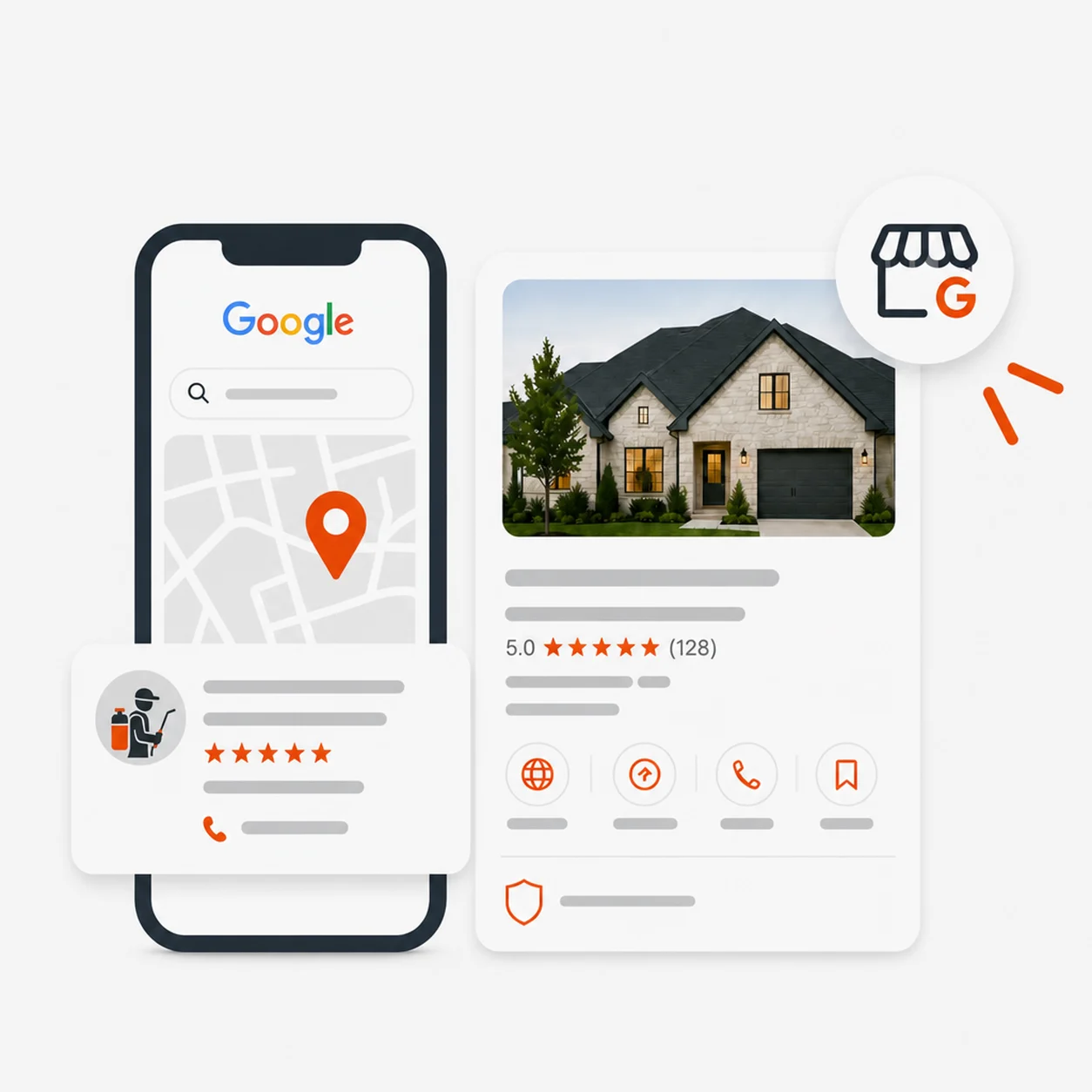
Local SEO for pest control companies: the complete guide
How pest control companies get found on Google Maps, in local results and in AI answers: your profile, reviews, city pages, listings and tracking.
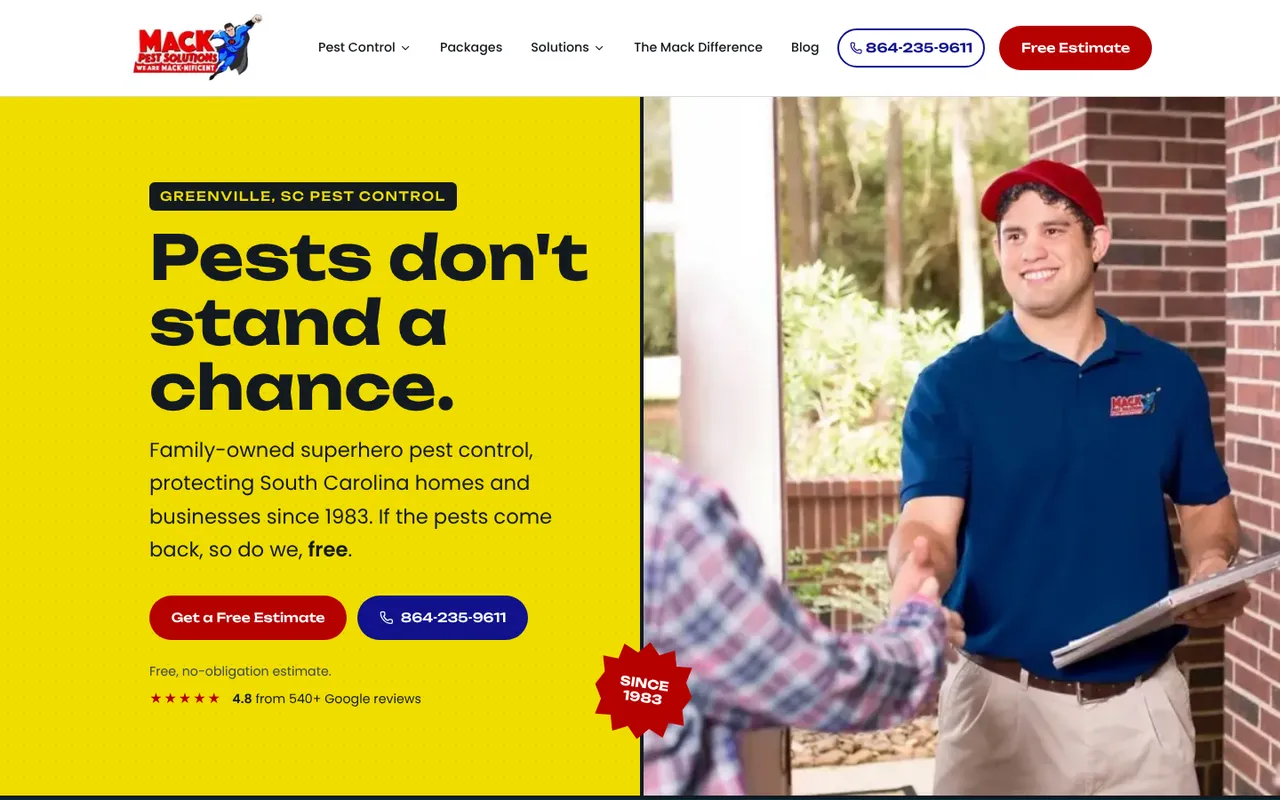
Best pest control websites: real examples and what they get right
12 real pest control websites with desktop and phone screenshots, plus the specific things each one does well that you can copy on your own site.